
Headway
June 2026 Chronic Pain Project updates, writings and tidbits


June Musings
Happy summer, chronic pain community! This month we’re sharing a first-person look at living with migraine, as well as updates from our artists and ways to celebrate with pride. Read on for ideas, stories and resources.
Life as a Gen Z Migraine Girl
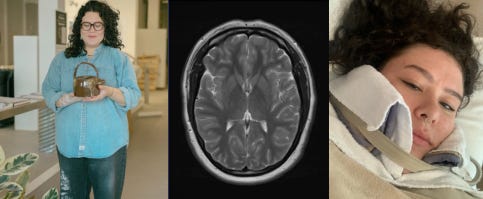
By Abi Martens, Chronic Pain Project Social Media Volunteer
June is Migraine and Headache Awareness Month (MHAM), a global initiative dedicated to de-stigmatizing the neurological disease, educating the public, and supporting the over 1 billion people worldwide who live with it.
One of the loneliest parts of chronic migraine is how misunderstood the condition is.
As strange as it sounds, I often find myself thinking about what it would be like to have a different condition that is easily understood in our society.
Chronic migraine is a severe, disabling neurological disorder defined as experiencing headaches on 15 or more days per month for at least three months.
Or if you’re me, every day of the month.
If you’ll stay a while, I would like to share my story with you. ❤️
If you don’t know me, my name is Abigail and I’m a 24-year-old artist and human from the middle of Canada.
When I developed chronic migraine at 21, my illusion of wellness was flipped upside down.
I started developing daily headaches in 2022 that progressed into chronic migraine. Pain moved into my life and never left. Discomfort was my new baseline. I can remember the week that it just never went away. I didn’t hit my head, nothing strange happened, I was a fit and otherwise healthy 21 year old. I was (and am) even completely sober for my health.
Here’s the thing nobody tells you about chronic conditions and many illnesses. Before I was a chronic pain patient, I assumed if you are ill or in pain, you go to the doctor, and they will fix it. And if the doctor can’t fix it, well, I’ll just go to acupuncture, or find a supplement. Anyone reading this with chronic health issues will get a kick out of that. Anyone without is like wait wtf.
I have come to learn that our bodies are more complicated than that. If you have good doctors like me, they will do everything in their power to help you get better. They listen, they get the scans for you, and they help you with treatment options. But that doesn’t guarantee results.
The first year I tried everything.
Preventative Medications
Weekly Physiotherapy
Dry Needling
Brain CT
Massage (Even cranial sacral massage - a lady massaged the inside of my mouth???)
Vitamins (I actually do recommend magnesium and CoQ10)
Acupuncture
So many lifestyle changes
Therapy (always)
Wisdom teeth removal
Jaw specialist
New glasses and regular vision tests
+ more. I mean I could literally go on and on.*
*The weirdest part is I feel like I need to list those things because I already assume people reading this will think “well she hasn’t tried ____ ” or “if she just did this diet.”
Especially with migraine, people think there’s a quick fix. Some people like to assume the reason other people have chronic illness is because they’re doing something wrong. Because it makes them feel like if they do everything right, they will be healthy forever, in their safe little health bubble. And honestly, that used to be what I thought.
Anyway. My lifestyle shifted dramatically at this time as I had to slow everything down. I couldn’t work as much, couldn’t go out as much. At this time my partner and I adopted a cat so I wouldn’t have to be home alone so often in pain. I highly recommend.
This past third year in chronic pain I have been trying some more targeted treatments such as migraine botox, and trying to expand my world. Trying things I avoided the previous two years such as going to concerts, the beach, exercising, and travel. There’s things that I want to do regardless of if my condition ever improves.
What I wish everyone knew about chronic migraine …
One of the hardest parts of chronic pain is that it is invisible. While it allows for privacy of your medical condition, it also allows you to not be seen. I have found this incredibly challenging especially as a young person. There’s a massive disconnect between your outer world and your inner world. I find it strange and uncomfortable to have to choose who I tell how I’m feeling and when. Even writing this substack makes me uncomfortable because people can read it who aren’t aware of the extent of my condition!
Masking pain comes naturally as a survival mechanism to us with chronic pain. Think about it. If you stub your toe once, it’s appropriate to have a big reaction. Show everyone how much it hurts. But if you stub your toe every hour, you can’t just act like that every hour, every day. People would think you are crazy. And you would feel consumed by it. It’s in your best interest to act like a normal person so you can feel belonging in society. That’s the best I can describe it.
Nobody takes medication because they want to. No one jumps right to injections, or pills. In fact, at least in Canada, you have to try less targeted treatments first and fail those treatments before you are offered migraine specific treatments. Trust me, if the vitamins worked, we would rejoice. Treatments are expensive and freaky. So be kind, don’t make chronic pain patients feel worse for taking medications made for our condition.
Another difficult part is fatigue. My pain is typically low enough that I can distract myself from it for a while and do tasks, work, hobbies. However, my energy levels and nervous system are incomparable to my body before chronic pain. I can’t work full time and need a lot more rest than most people between things. I wish people understood that even if my migraine may not be severe in that moment, I am probably very fatigued still from years of ongoing discomfort.
Many days, the emotional rollercoaster is worse than the pain. The anxiety and hopelessness that comes with chronic illness can feel like the heaviest dark cloud over every aspect of your life. I go to therapy, have a very patient partner, kind friends, and my parents are the best when I’m spiraling. Even your best memories have pain attached to them in ways you can’t ignore and it causes a lot of grief. The bravery required to try new medications and treatment can be difficult to find. There’s a lot of risk involved - if a new medication flares me up, then it’s very hard for me to be present in my life that I love so deeply. Besides, who wouldn’t be scared to get 32 needles in their head?? It’s not fun. (Google migraine botox).
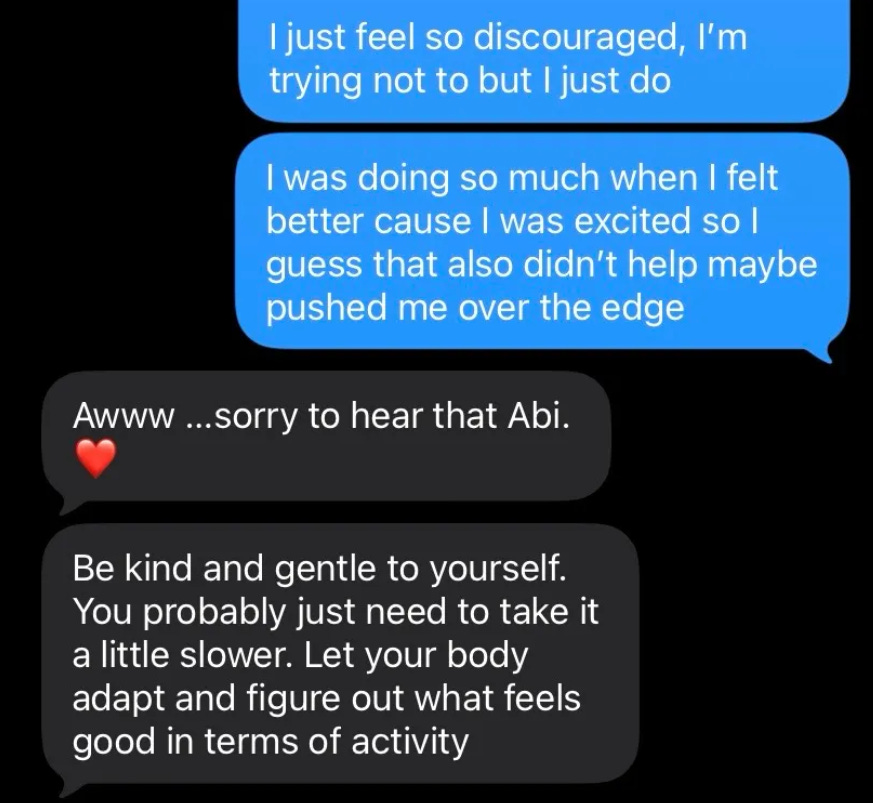
That being said, migrainers (and anyone with chronic pain) can be reliable people. I am excellent at my job/s and always show up professionally and reliably. I am known as an involved family member and friend, often bringing homemade food and baking to gatherings, or helping out. While consideration of our limits is of course appreciated, know that for many of us, having tasks and community brings meaning to our lives. (: It is not a burden to ask us to do things.
No one talks about the financial side. While I am fortunate to be financially stable, a lot of my money does go to treatments, medications, and therapy. Plus, I can’t work as much as many people. I for sure wish more people knew this, I feel it is not often considered by loved ones of chronic illness patients in general.


I am not sure how to wrap this up. I guess I would like to re-iterate that migraine is a neurological condition, impacting everything from energy levels, mental health, relationships, finances, and so much more. I know it has been for me. That’s why awareness is needed. Because when I tell someone I have migraine/s, and they suggest that ear piercing or a Coke, I feel extremely awkward. (Like, thanks, should I suggest that to my neurologist ??? Lol.)
Thank you for reading and taking a moment to understand my lived experience as a young person with chronic pain. Especially if you are in my life. It means a lot to me.
And of course, to everyone with chronic pain, especially young women, know that you are not alone.
How do you handle the lonely or misunderstood parts of your chronic pain or chronic condition(s)? We’d love to hear from you in the comments below.
Hear from Our Artists
Not only do our artists create moving pieces, they also have fascinating life stories. In a 3-4 minute video, each artist shares more about their chronic pain story and talks in depth about the piece(s) they’ve created for our exhibits.
This month we profile Daphne, who talks about life with chronic migraine and her self-portrait that harkens back to Van Gogh. She remembers having headaches as a small child, but her Midwestern parents told her, “You’re tough, suck it up.” When she lost the ability to run long distance, she turned to a master’s degree in fine art painting.
“It’s difficult to put a smile on your face … when you don’t feel like smiling.”
Click to watch the video on YouTube.
Did you know you can support artists with chronic pain? Your donation removes barriers like shipping costs for artwork, provides art supplies to participants who face financial limitations, and allows artists to share their stories through sliding scale and free programming.
News & Events
Lead a Chronic Pain Project Workshop: Are you passionate about chronic pain, mental health and the arts? Do you have a skill you’d like to share with our community, from visual art to writing, journaling, breathwork, self-care, crafts, etc.? All of our workshops are focused on people who live with chronic pain. Participants will have varying levels of artistic training and ability but all are seeking an outlet for creativity and connection. Fill out this form to get started.

Attend Accessible Virtual Pride 2026: If chronic pain or disability keeps you from joining in-person Pride Month celebrations, check out the fourth annual Accessible Virtual Pride. This online event, hosted by One Free Community and Calling Up Justice, allows folks to gather to celebrate disabled LGBTQIA+ community in a safe and accessible space. The event runs July 4 on Zoom and July 5 on YouTube and is free to attend. Click here to RSVP, learn more about the event or provide support.

Learn About PTSD Awareness Month: June’s Post-Traumatic Stress Awareness (PTSD) Month may also apply to the chronic pain community, as chronic pain and PTSD can be locked in a vicious cycle. According to PTSD UK, “Research has shown that one of the most common physical problems reported by those with PTSD and C-PTSD is ‘pain’. … [S]ome symptoms of PTSD and C-PTSD can cause pain; for example, hyperarousal symptoms (feeling on edge, scared of your surroundings and ‘on guard’) can often lead to tense muscle pain that can in turn become chronic.” Learn more from the U.S. National Center for PTSD.
Like what you’re reading? Pass it on!
Want to find out about all of our upcoming exhibits, workshops and events? We’ve moved to a separate weekly(ish) newsletter format.
These articles are not meant to replace medical advice. Talk to your doctor about your specific situation.
That’s all for this month. Comment below with any ideas, questions or just to say “hi”!
Jennifer Roop, Board Secretary
We are a 501(c)(3) organization
Abigail (and Jennifer), thank you so much for this post. Struggling with an invisible illness like chronic migraines makes being sick ten times as challenging. I suffered from chronic pain for 15 years, and was forced to live lying down. And I can't tell you the number of times someone (including doctors) said "Well, you LOOK fine." grrr.
Thanks for your honest perspective of life with migraines and chronic pain. I related a lot to several emotions and situations in this post, and have suffered from migraines for years. The way that you describe the fatigue and exhaustion really resonates. ❤️🩹